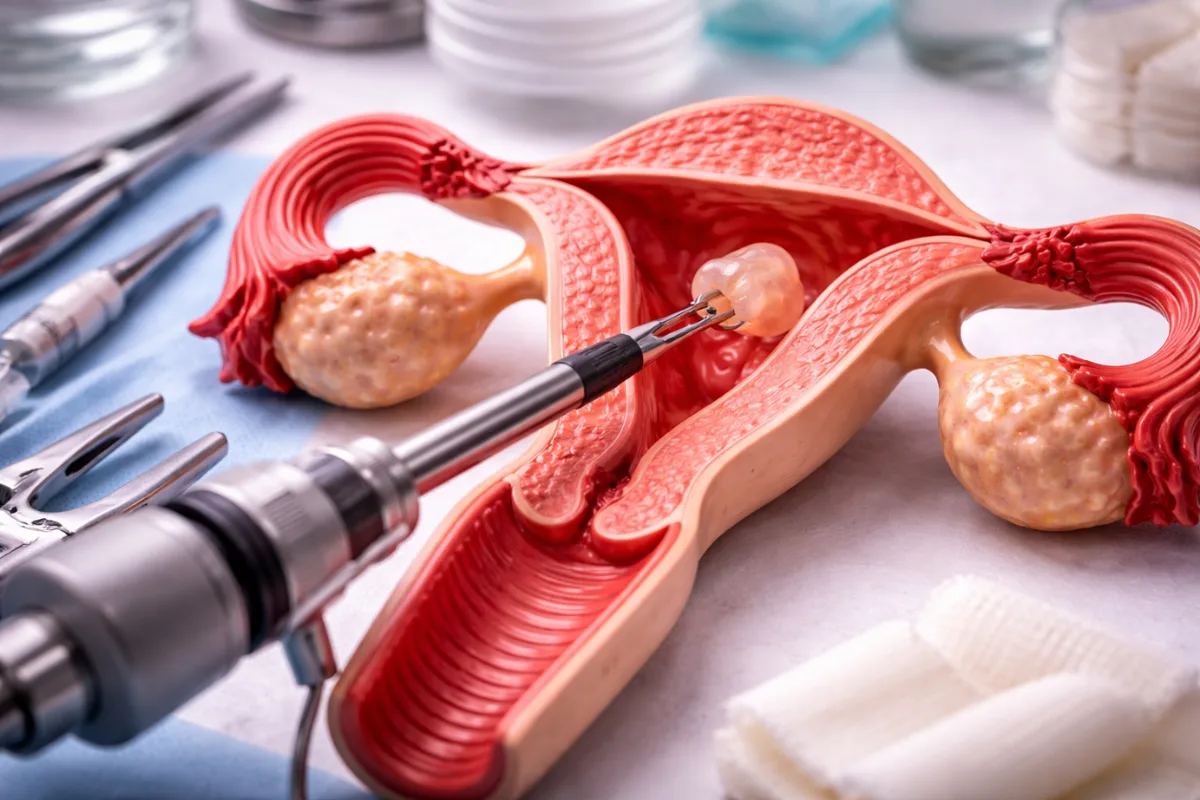
Hysteroscopic polypectomy is a minimally invasive procedure used to remove polyps from inside the uterus. These polyps are small growths that can sometimes cause heavy bleeding, spotting between periods, irregular bleeding, or interfere with conception.
For some women, a polyp is found during a scan done for abnormal bleeding. For others, it comes up during fertility workup, even when there were no obvious symptoms. When a polyp is inside the uterine cavity, removing it through a hysteroscopic approach is often the most direct and effective way to treat it.
Hysteroscopic polypectomy is a procedure used to remove a uterine polyp using a hysteroscope, which is a thin camera-guided instrument passed through the vagina and cervix into the uterus.
Because the camera goes directly into the uterine cavity, the polyp can be seen clearly and removed precisely, without any cuts on the abdomen. This makes the procedure both accurate and minimally invasive.
Not every polyp causes symptoms, but when it does affect bleeding, fertility, or the shape of the uterine cavity, removal may be recommended.
Hysteroscopic polypectomy may be recommended for women who have:
The decision to remove a polyp depends on its size, location, symptoms, and whether it may be affecting fertility or the uterine environment.
The first step is confirming that the polyp is likely to be the reason behind the symptoms or fertility concern. Dr. Neha Lalla will review your menstrual history, scan findings, bleeding pattern, and reproductive goals before planning treatment.
This helps ensure the procedure is being done for the right reason and at the right time.
A thin hysteroscope is passed through the vagina and cervix into the uterus. The cavity is gently expanded with fluid so the polyp can be seen clearly.
Using fine instruments, the polyp is carefully removed under direct vision. Because the treatment is targeted and performed inside the uterus, there is no need for abdominal incisions.
The removed tissue may be sent for further examination where appropriate.
Recovery is usually straightforward. Mild cramping, light bleeding, or watery discharge may happen for a short time after the procedure. Most women return to normal routine quite quickly.
You will be given clear guidance about recovery, follow-up, and what the findings mean for your next step, especially if fertility is part of the picture.
The main advantage of hysteroscopic polypectomy is that the polyp is removed under direct vision, which makes treatment accurate and targeted.
The procedure is done through the cervix, so there are no external cuts or scars.
When a polyp is the reason for spotting, irregular bleeding, or heavy periods, removing it can make a clear difference.
If a polyp is affecting the uterine cavity, removing it may help improve the environment for implantation.
Most women recover quickly and are back to normal activities soon after the procedure.
A hysteroscopic approach allows the cavity to be examined properly and the polyp to be treated in the same sitting.
A uterine polyp is a small growth that develops from the lining of the uterus. Some polyps cause symptoms such as bleeding or spotting, while others are found incidentally on scans.
Not always. Removal is usually advised when the polyp is causing symptoms, appears significant on imaging, or may be affecting fertility or implantation.
No. The procedure is done through the vagina and cervix using a hysteroscope, so there are no abdominal cuts.
In selected cases, yes. If a polyp is interfering with the uterine cavity, removing it may improve the environment for conception or implantation.
Some women may experience mild cramping or discomfort, but the procedure is generally well tolerated. Dr. Neha will explain what to expect in your case.
Most women recover quickly, with only mild cramping or spotting for a short time. Normal activities are often resumed soon afterwards.
You should contact the clinic if you have heavy bleeding, severe pain, fever, foul-smelling discharge, or any symptom that feels unusual after the procedure.
If you have been told you have a uterine polyp, or you are dealing with spotting, heavy bleeding, or fertility concerns that may be linked to the uterine cavity, Dr. Neha Lalla offers careful assessment and precise hysteroscopic treatment.
When the problem is inside the uterus, the most effective treatment is often the one that deals with it directly.

Dr. Neha Lalla is an Obstetrician & Gynecologist with 6 years of experience inclusive of 3 years of exclusive experience in Gynecological Endoscopy (Laparoscopy & Hysteroscopy surgery).