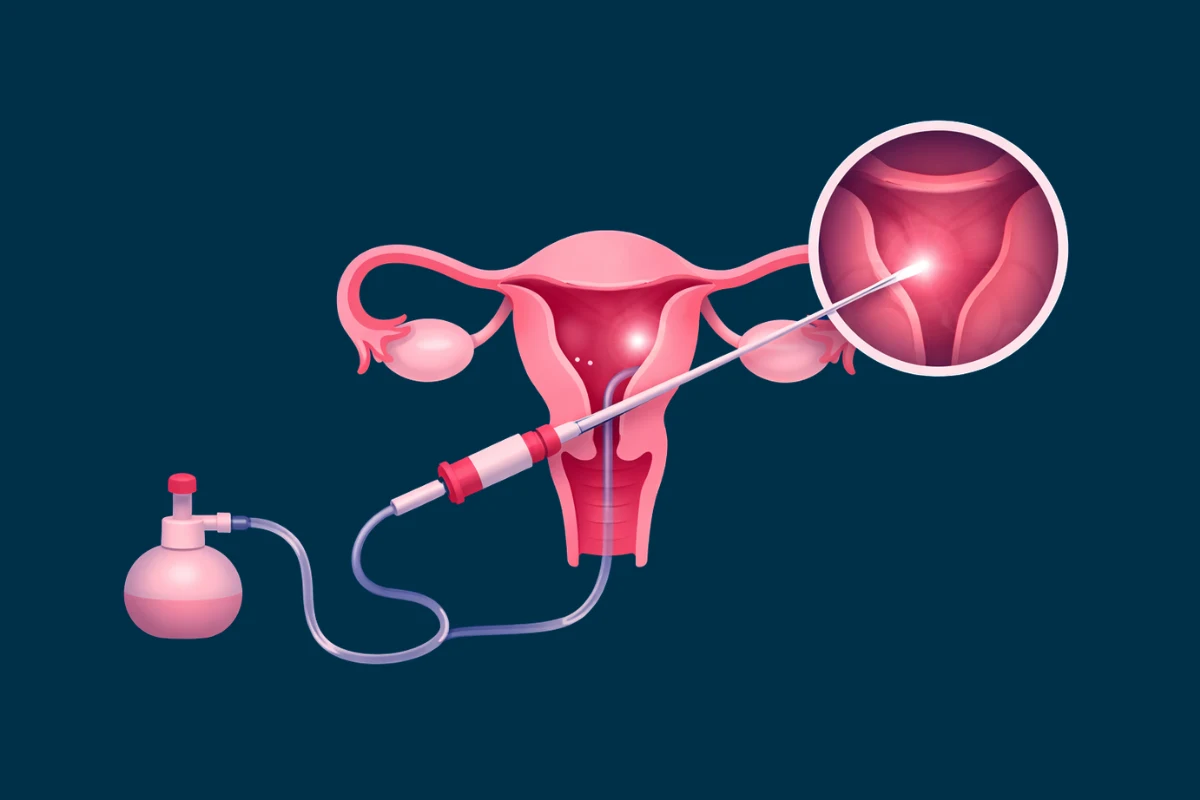
Fertility hysteroscopy is a detailed evaluation of the inside of the uterus for women who are struggling to conceive or have experienced recurrent miscarriage. It is often recommended when there is a need to assess the uterine cavity more clearly, especially when scans look normal but the pregnancy journey still is not moving forward.
For many women, this is the step that brings clarity. A polyp, scar tissue, subtle septum, small fibroid inside the cavity, or another structural issue may not always be fully picked up on routine imaging. Fertility hysteroscopy helps look directly at the uterine cavity and, in many cases, treat the problem at the same time.
Fertility hysteroscopy is a hysteroscopic procedure used to assess the inside of the uterus as part of fertility or recurrent miscarriage workup. A thin camera is passed through the vagina and cervix into the uterus, allowing the uterine cavity to be seen directly on a screen.
This matters because implantation depends not only on ovulation and embryo quality, but also on the condition of the uterine cavity. Even a small structural issue inside the uterus can affect implantation or the ability to maintain a pregnancy.
In some cases, fertility hysteroscopy is purely diagnostic. In others, if a small problem is found, treatment can be done during the same sitting.
Fertility hysteroscopy may be recommended for women who have:
It is especially useful when the next step in fertility planning depends on knowing whether the inside of the uterus is normal.
The first step is understanding where fertility hysteroscopy fits into your fertility journey. Dr. Neha Lalla will review your medical history, cycle pattern, previous scans, miscarriage history if relevant, and any prior fertility treatment or investigations.
This helps determine whether the uterine cavity needs closer assessment and whether hysteroscopy is likely to add useful information.
A thin hysteroscope is passed through the vagina and cervix into the uterus. The cavity is gently expanded with fluid so the inner lining can be seen clearly.
This allows direct assessment for issues such as:
If a small and treatable issue is found, it may often be managed during the same procedure, depending on the plan and findings.
Recovery is usually simple. Some women may notice mild cramping or light spotting for a short time afterwards, but most return to normal activity quickly.
You will be guided on follow-up, findings, and what the results mean for your next fertility step.
This is one of the biggest advantages. Instead of relying only on scans, fertility hysteroscopy allows the inside of the uterus to be seen directly.
Small polyps, mild adhesions, subtle septum, or small intracavitary fibroids may not always be fully appreciated on standard imaging.
A clear uterine cavity assessment helps make fertility planning more precise, whether you are trying naturally or undergoing treatment.
If a minor issue is found, it may often be addressed during the same procedure, which saves time and avoids delay.
When pregnancy loss keeps happening without a clear reason, evaluating the uterine cavity more closely can be an important part of finding answers.
Because the procedure is done through the cervix, there are no abdominal cuts, and recovery is usually straightforward.
Because some uterine cavity problems are too small or subtle to show clearly on routine scans. Hysteroscopy gives a direct view, which can reveal issues imaging may miss.
If a uterine cavity problem is found and treated, it may improve the environment for implantation or pregnancy in selected cases. The benefit depends on what is found and the overall fertility picture.
Some women experience mild cramping or discomfort, but it is generally a well-tolerated procedure. Dr. Neha will explain what to expect in your case.
No. The procedure is done through the vagina and cervix, so there are no abdominal cuts.
Yes, it can be an important part of evaluating women with recurrent miscarriage, especially when a uterine cavity issue may be contributing.
Most women recover quickly and return to normal activities within a short time, depending on whether any treatment was done during the procedure.
You should contact the clinic if you have heavy bleeding, severe pain, fever, foul-smelling discharge, or any symptom that feels unusual afterwards.
If you are struggling to conceive, have had recurrent miscarriage, or want a clearer understanding of the uterine cavity before moving forward with fertility treatment, Dr. Neha Lalla offers fertility hysteroscopy with a careful, structured approach.
Sometimes the answer is not in another test. It is in looking directly at the place where pregnancy needs to begin

Dr. Neha Lalla is an Obstetrician & Gynecologist with 6 years of experience inclusive of 3 years of exclusive experience in Gynecological Endoscopy (Laparoscopy & Hysteroscopy surgery).