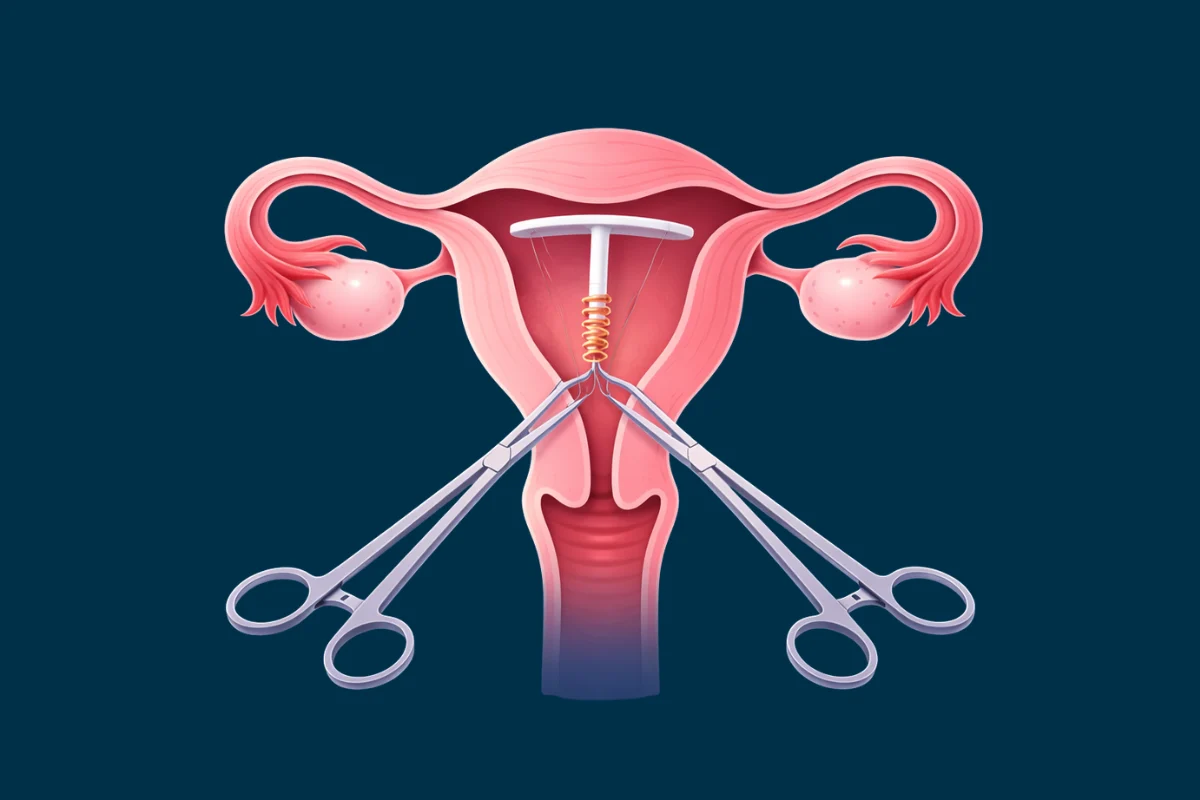
A retained IUD can be worrying, especially when a routine removal has not worked or the threads are no longer visible. In many cases, the device is still inside the uterus but cannot be removed in the usual way. When that happens, a more careful and planned approach is needed.
Dr. Neha Lalla offers retained IUD removal in Dubai, including hysteroscopic removal when routine removal is not possible. The aim is to remove the IUD safely, avoid unnecessary discomfort, and understand exactly why it has become difficult to remove in the first place.
Retained IUD removal is the planned removal of an intrauterine device that cannot be taken out in the usual way. This may happen if the IUD threads are not visible, the device has shifted, the strings have retracted into the cervix or uterus, or the IUD feels stuck during an attempted removal.
In some cases, the device can still be removed in clinic with the right technique. In others, hysteroscopy may be needed. This involves using a thin camera passed through the cervix into the uterus so the IUD can be seen directly and removed more precisely.
The key point is that a difficult IUD removal should not be forced. It should be assessed properly and managed in a way that is both safe and comfortable.
Retained IUD removal may be recommended for women who have:
Some women discover the issue during a routine removal visit. Others come in because of pain, bleeding, or because the IUD needs to be removed and the strings cannot be found.
The first step is understanding where the IUD is and why routine removal has not worked. Dr. Neha Lalla will review your symptoms, the type of IUD, when it was inserted, whether removal has already been attempted, and what the scan or examination shows.
This is important because not every retained IUD needs the same approach. Sometimes the strings are simply retracted. In other cases, the device may be embedded or positioned in a way that needs direct visualisation.
If the IUD can be removed safely in clinic, that may be attempted using the appropriate technique. If not, hysteroscopic removal may be advised.
In hysteroscopic IUD removal, a thin camera is passed through the vagina and cervix into the uterus. This allows the IUD to be seen directly, and fine instruments are used to remove it under vision. No abdominal cuts are needed.
This approach is especially helpful when the strings are missing, the device is partially embedded, or previous removal attempts have not been successful.
Recovery is usually straightforward. Mild cramping or light spotting can happen for a short time afterwards, especially if hysteroscopy is used. Most women recover quickly and return to normal routine soon after the procedure.
You will also be guided on what comes next, whether that means replacing the IUD, switching contraception, or planning for pregnancy.
The main benefit is that the IUD is removed in a controlled and planned way, without unnecessary force or discomfort.
If hysteroscopy is used, the device can be seen directly, which makes removal more precise.
Even when hysteroscopy is needed, the procedure is done through the cervix, so there are no external incisions.
This may include missing threads, string retraction, embedding, or a change in position.
Once the IUD is removed, you can move forward with replacement, alternative contraception, or pregnancy planning more confidently.
Most women recover quickly and can return to normal activities soon after the procedure.
It usually means the threads are no longer visible at the cervix. Sometimes they have simply retracted upward, and sometimes the IUD position needs to be checked with ultrasound.
Not always, but it does need proper assessment. If the IUD cannot be removed routinely, it is important to confirm its position and remove it safely.
Not in every case. Some IUDs can still be removed in clinic. Hysteroscopy is usually recommended when the strings are not accessible, the device is stuck, or previous removal attempts have failed.
Some discomfort or cramping can happen, but the procedure is planned to make removal as safe and manageable as possible. Dr. Neha will explain what to expect based on the method being used.
In many cases, yes. This depends on the reason for removal and whether immediate replacement is appropriate.
Recovery is usually quick. Mild cramping or spotting may happen for a short time, but most women return to normal routine soon afterwards.
You should contact the clinic if you have heavy bleeding, severe pain, fever, foul-smelling discharge, or any symptom that feels unusual after removal.
If your IUD strings are missing, a removal attempt has not worked, or you have been told the device is stuck or retained, Dr. Neha Lalla offers careful evaluation and safe removal based on the exact situation.
When routine removal is not possible, the right next step is a planned one.
Dr. Neha Lalla is an Obstetrician & Gynecologist with 6 years of experience inclusive of 3 years of exclusive experience in Gynecological Endoscopy (Laparoscopy & Hysteroscopy surgery).